How to open a café in Germany: a step-by-step plan
More than a third of everyone who opens a food business in Germany is a foreigner. Cafés, snack bars and restaurants are one of the few industries where you can start without a German degree and with imperfect German. But between “I want my own café” and the first coffee sold stands a chain of offices: Gewerbeamt, Finanzamt, Gesundheitsamt, Lebensmittelüberwachung, sometimes Bauamt and Ordnungsamt.
This article walks the whole path in order: which permits you need, where to go, what to bring, what it costs, and where people most often lose time and money. No legal fog — explained the way someone who has walked this path would explain it.
This article is for information only and does not replace legal or tax advice. Fees and requirements differ from city to city — your local office quotes the exact amounts.
- Step 0. Concept, money and the right premises
- Step 1. Registering the business: Gewerbeanmeldung and the tax office
- Step 2. Food means extra supervision: registration and the Belehrung
- Step 3. Alcohol: when you need a Gaststättenerlaubnis
- Step 4. The premises: Nutzungsänderung, terrace, food truck
- Step 5. Self-monitoring: HACCP, allergens, prices
- Step 6. Cash register, insurance and mandatory registrations
- What it costs and how long it takes
- Typical mistakes that cost more than all the fees
Step 0. Concept, money and the right premises
Before your first trip to any office, settle two questions: what you live on for the first six months, and which premises you take. A small snack bar or takeaway coffee shop realistically starts from €20–40k (rent with deposit, basic equipment, first stock, a reserve). A full café with a kitchen and seating is more often €50–100k and up. Banks and KfW loans will ask for a business plan; even if you don't need credit, do the unit economics early — German rent eats weak concepts fast.
The premises decide half of your bureaucracy. If the space already housed gastronomy, you inherit the most expensive parts: approved use of the rooms, extraction, sanitary facilities, fire-safety compliance. If it used to be a shop or an office, you'll need a Nutzungsänderung — a change of use through the Bauamt with an architect, which means months of time and thousands of euros (more below). That's why experienced restaurateurs almost always look for former cafés — even paying the previous tenant a transfer fee (Ablöse) works out cheaper.
Step 1. Registering the business: Gewerbeanmeldung and the tax office
Gewerbeanmeldung is the registration of your trade at your city's Gewerbeamt. You need your passport, a residence permit allowing self-employment if applicable, and the address of the future venue (they usually ask for the rental contract). The fee is typically €20–60, and many cities handle it online. There is no special “café licence” in Germany: without alcohol, in most federal states the Gewerbeanmeldung plus the registrations below are enough.
Important for non-EU citizens: your residence permit must allow self-employment (selbständige Tätigkeit). EU citizens need nothing extra, and Ukrainians under §24 (temporary protection) are allowed to be self-employed — the card usually says “Erwerbstätigkeit erlaubt”.
After the Gewerbeanmeldung, the tax office itself will invite you to fill in the Fragebogen zur steuerlichen Erfassung — the tax registration questionnaire, submitted through the ELSTER portal. The key fork is the Kleinunternehmerregelung (§19 UStG): with a turnover of up to €25,000 a year you can skip VAT entirely. It simplifies a small start, but a café with normal revenue outgrows the scheme quickly — do the maths with a tax adviser. Your tax number (Steuernummer) arrives by post within 2–6 weeks.
Step 2. Food means extra supervision: registration and the Belehrung
Anyone who prepares or sells food is a Lebensmittelunternehmer (“food business operator”) under EU Regulation 852/2004 and must register the venue with the food-control authority (Lebensmittelüberwachung, often part of the Veterinäramt) — before opening. Registration is free, and in many cities it's a simple online form. It puts you on the inspection schedule — an inspector can show up at any time, unannounced.
The second duty is the Belehrung nach §43 Infektionsschutzgesetz: a hygiene instruction at the Gesundheitsamt. The owner and every employee must complete it before their first working day — around €20–35 per person; the certificate never expires, but the employer must repeat an internal instruction every two years and document it. A cook's missing Belehrung is one of the most common findings in inspections.
Step 3. Alcohol: when you need a Gaststättenerlaubnis
Selling food and soft drinks needs no licence in most federal states. The moment alcohol appears — a beer with lunch, an aperitif, mulled wine on the terrace — your state's gastronomy law kicks in, and you usually need a Gaststättenerlaubnis (permit to serve alcohol) from the Ordnungsamt.
- Gaststättenunterrichtung at the IHK — a mandatory seminar on gastronomy rules (a few hours, roughly €50–150).
- Führungszeugnis (criminal-record certificate, €13) and Auszug aus dem Gewerbezentralregister (€13) — ordered at the Bürgeramt.
- Unbedenklichkeitsbescheinigung from the Finanzamt — confirmation that you owe no taxes.
- The Gaststättenerlaubnis itself — the fee depends on the city and floor area, usually from one to several hundred euros. For a one-off event a cheap Gestattung replaces it.
Step 4. The premises: Nutzungsänderung, terrace, food truck
If the space wasn't gastronomy before, the Bauamt must approve a Nutzungsänderung — a change of use. You'll need an architect, floor plans, a fire-safety concept, extraction, guest toilets, sometimes parking spaces. This is the longest and most expensive item on the whole list: several months to a year, and from a few thousand euros. Before signing a lease, get written confirmation from the Bauamt that gastronomy is permitted at that address — a signed rental contract is no argument without an approved use.
Tables on the pavement or a terrace on public ground require a Sondernutzungserlaubnis from the Ordnungsamt — you pay per square metre per season, and every city sets its own rates.
A food truck follows its own branch: a Reisegewerbekarte (itinerant trade card), permits for the pitch (Standplatz), and — if there's gas on board — a regular Gasprüfung by a certified specialist.
Step 5. Self-monitoring: HACCP, allergens, prices
From day one the law requires you to run your own control system. First, a HACCP concept (EU Regulation 852/2004): a written description of where the critical points are in your kitchen (chilling, cooking through, hot holding) and how you control them. It comes with daily logs: fridge temperatures, goods receiving, cleaning, frying fat. The inspector reads exactly those logs: blank pages for last month can't be explained away with “we just forgot to write it down”. Records are kept for at least two years.
Second, allergen labelling under the LMIV regulation: 14 allergen groups (gluten, milk, eggs, nuts and so on) must be stated in writing for every dish on the menu — a verbal “ask the waiter” is not enough. Missing labelling is fined, and systematic violations reach four to five figures.
Third, the small print you'd otherwise learn from the inspector: menu and display prices per PAngV (full price incl. VAT), and the mandatory notices on the wall — above all the Jugendschutzgesetz (youth-protection act) if you serve alcohol.
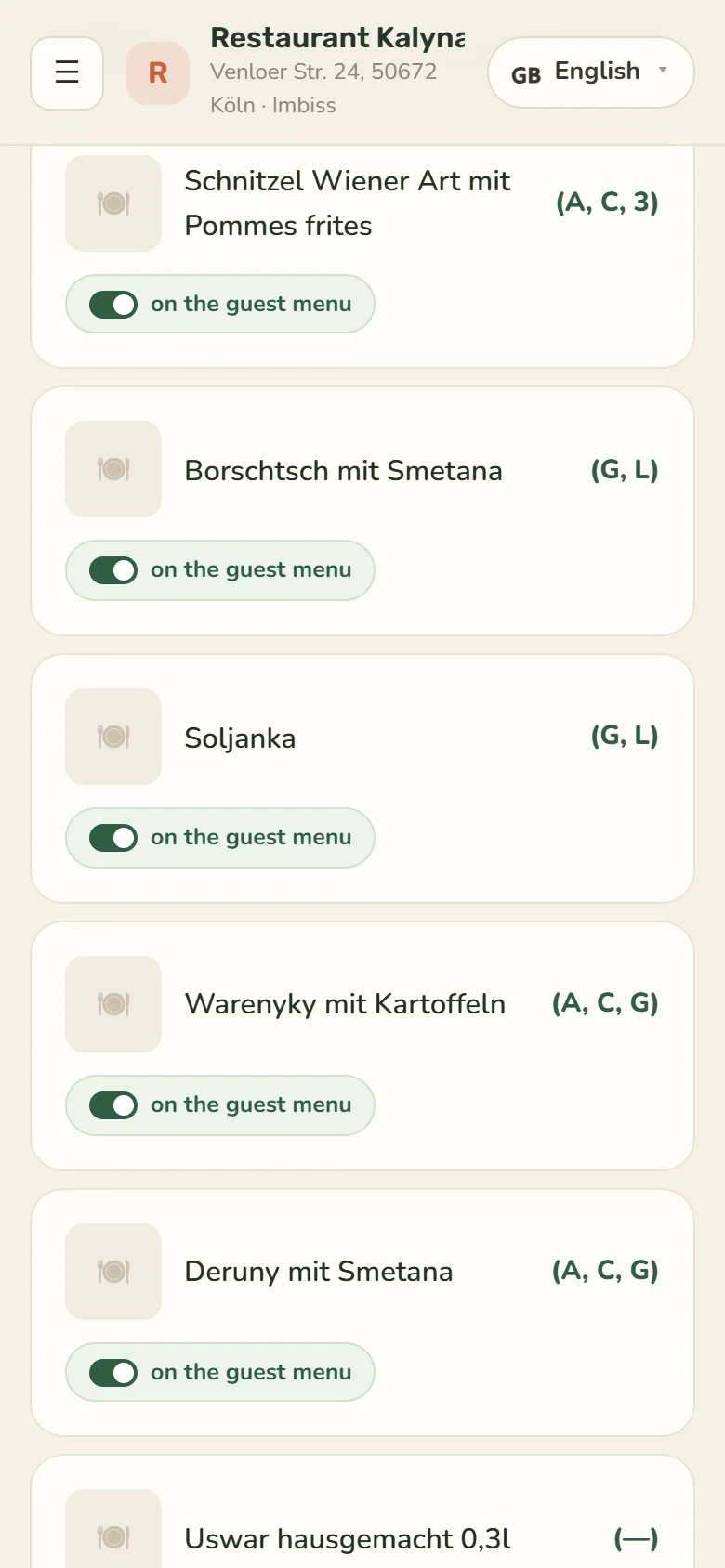
In Servio you enter your recipes in your own language — allergens are detected automatically, the menu and HACCP logs assemble themselves, and the documents come out in German, exactly as the inspector expects them.
Try it for free →Step 6. Cash register, insurance and mandatory registrations
An electronic cash register must have a TSE (certified security module, KassenSichV), print a receipt for every sale (Bonpflicht) and be registered with the tax office via ELSTER. In theory you may run an “open till” with no hardware, but in practice that guarantees questions at your first tax audit.
- Berufsgenossenschaft (BGN) — the trade's statutory accident insurance. Registering the business within a week of starting is mandatory, even with no employees yet.
- Rundfunkbeitrag — the broadcasting fee for business premises (a few euros a month for a small venue), registered online.
- GEMA — if music plays or a TV runs in your dining room, you need a licence; the tariff depends on area and format.
- Betriebshaftpflichtversicherung — liability insurance towards your guests (a slip, a food poisoning). Legally voluntary, practically essential: one incident without it can end the business.
- Hiring people adds a Betriebsnummer from the Agentur für Arbeit, social-insurance registration for every employee, minimum wage and working-time records.
What it costs and how long it takes
The permits themselves are the cheapest part of opening: all fees together usually stay within €200–600 (noticeably less without alcohol). The money goes elsewhere: deposit and Ablöse for the premises, renovation and extraction, kitchen equipment, first stock and a reserve for 3–6 months of living costs.
Time-wise: with premises that already housed gastronomy and no alcohol, the bureaucracy realistically takes 4–8 weeks. With a Gaststättenerlaubnis, add a few weeks for the certificates and the IHK. With a Nutzungsänderung you're counting in months — that path is only worth choosing for a really good lease.
Typical mistakes that cost more than all the fees
- Signing the lease before the Bauamt confirms in writing that gastronomy is permitted — the most expensive mistake there is.
- Letting staff into the kitchen without the §43 Belehrung — flagged at the very first inspection.
- Keeping HACCP logs “we'll fill them in later” — blank fields read as no self-monitoring at all, which is a fine.
- A menu without written allergen labelling — “ask the waiter” doesn't count.
- Ignoring letters from GEMA and the Rundfunkbeitrag — back-payments arrive for past periods.
- Pricing without minding 19% / 7% VAT — takeaway and dine-in are taxed differently, and that breaks your margins.
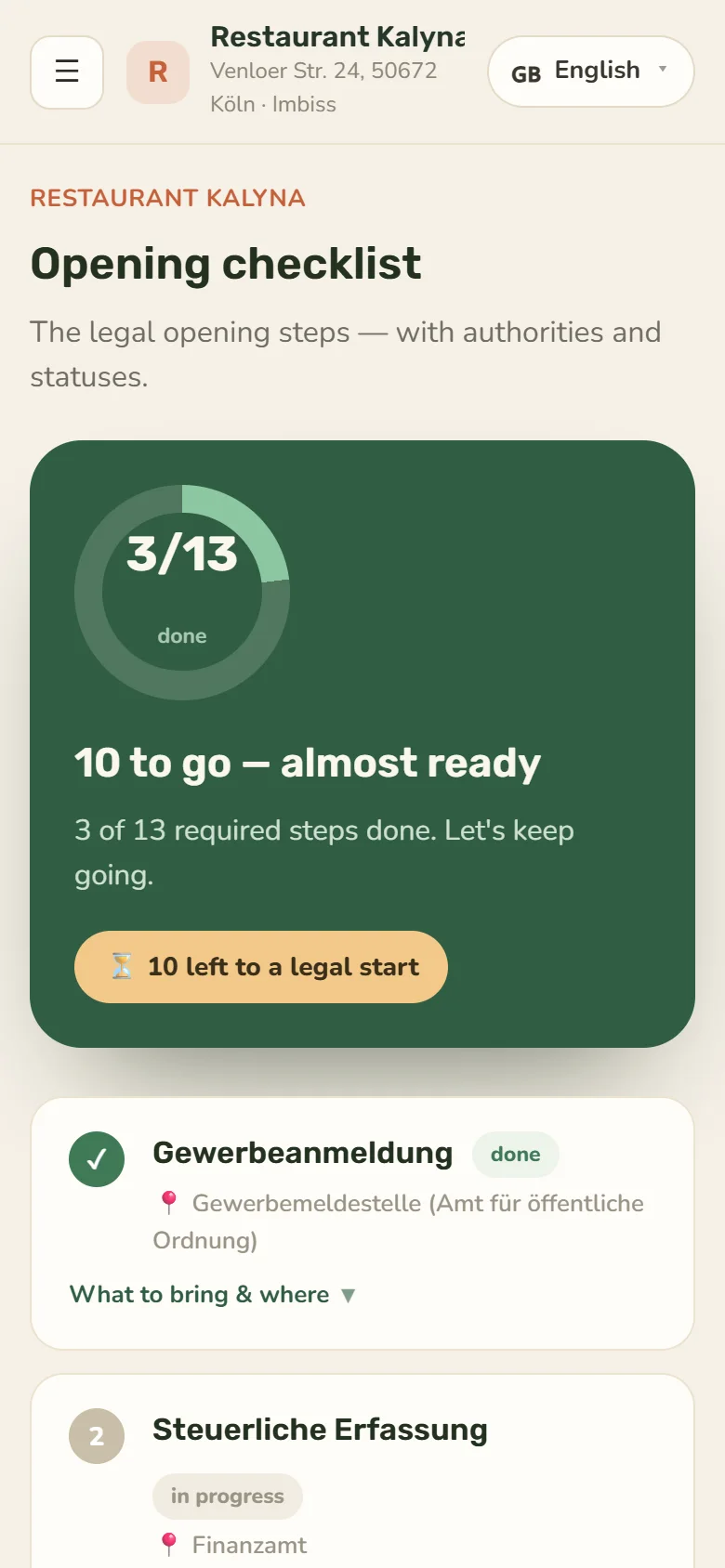
The 23 opening steps with statuses, your local office's address by postcode, a “what to bring” list for every visit — plus HACCP, allergens and a QR menu. Free plan, no card needed.
Start for free →Frequently asked questions
Can I open a café in Germany without German citizenship?
Yes. EU citizens need nothing extra. Citizens of other countries need a residence permit that allows self-employment; Ukrainians under §24 (temporary protection) are allowed to be self-employed.
How much do the permits and registrations themselves cost?
Usually €200–600 in total: Gewerbeanmeldung €20–60, §43 Belehrung around €20–35 per person, certificates for the alcohol licence around €26, the IHK seminar €50–150, the Gaststättenerlaubnis itself from one hundred to several hundred euros. The real budget goes into premises and equipment, not offices.
Do I need a chef's diploma or gastronomy training?
No. Only the §43 IfSG Belehrung is mandatory for everyone handling food, plus — if you serve alcohol — the Gaststättenunterrichtung at the IHK. The law doesn't test professional skill.
How long does opening take?
With former gastronomy premises and no alcohol — realistically 4–8 weeks. With an alcohol licence, add a few weeks. If a Nutzungsänderung is needed (the space wasn't a food business), expect several months up to a year.
What does the Lebensmittelkontrolle check, and how often does it come?
Hygiene of the rooms, storage temperatures, HACCP logs, allergen labelling, use-by dates. They come unannounced; the frequency depends on your venue's risk rating. Systematic violations bring four-to-five-figure fines and, in the extreme, closure.
Can HACCP logs be kept on paper?
Yes — the law doesn't demand digital form; what matters is that records are kept regularly and stored for at least two years. Digital logs are simply faster to fill in and impossible to lose; in Servio they're part of the free plan.